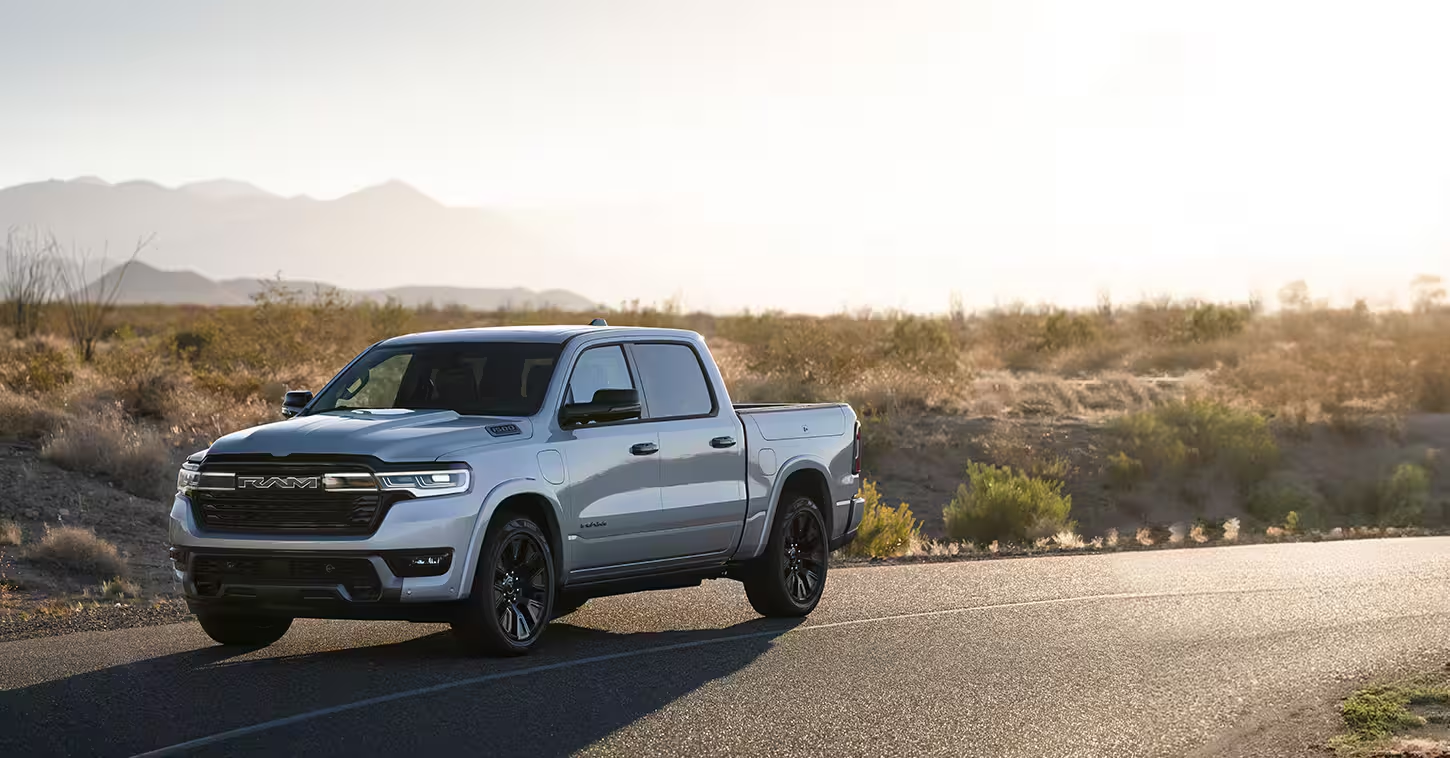
The Rise of EREVs: A New Era for Electrified Large Vehicles
By Adam Chehayeb
August 2026 marked a shift in global automotive trends. Range-extended electric vehicles (EREVs) offer a practical bridge for large SUVs and pickups.
The Evolving Landscape of Automotive Power: August 2026 and Beyond
August 2026 delivered a pivotal moment in the automotive world, signaling that the global transition away from conventional petrol power is entering a more practical and intricate phase. This wasn't about a single record-breaking vehicle; it was about the broader shift in how drivers power their journeys.
Battery-electric vehicles (BEVs) continue their ascent, demonstrating increasing buyer acceptance. During August, Australia saw over 27,000 electric vehicles sold, allowing EVs to outsell petrol-powered cars for the first time. In India, alternative-fuel vehicles—including EVs, hybrids, and compressed-natural-gas models collectively captured 41.95% of passenger-vehicle retail sales, surpassing petrol's 40.85% share in the same month.
These milestones highlight a growing willingness among buyers to consider diverse powertrains. However, they also underscore a crucial point: not every driver is ready to depend solely on a large battery and the public charging network. Concerns regarding long journeys, towing capacity, charging availability, and the time required to replenish energy remain significant, particularly for owners of large SUVs and pickup trucks.
Enter the Range-Extended Electric Vehicle (EREV)
This is precisely where the range-extended electric vehicle, or EREV, offers a compelling solution. EREVs promise the smooth response and immediate torque characteristic of electric propulsion, but crucially, they integrate a petrol engine that can generate electricity when the battery's usable charge depletes. This innovative approach allows drivers the convenience of plugging in for everyday electric travel while retaining the ability to refuel quickly during longer journeys.
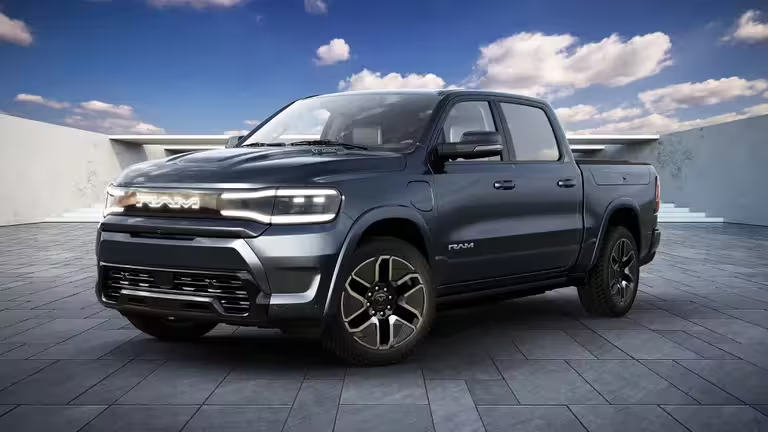
Major manufacturers are now taking the EREV concept seriously. Ram is actively developing the 1500 REV range-extended pickup, Jeep® is preparing an electrified Grand Wagoneer, and reports suggest Ford and Hyundai are also planning larger vehicles incorporating petrol-powered generators. Far from being a temporary engineering experiment, the industry is increasingly viewing the EREV as a viable answer for customers seeking electrification without exclusive reliance on charging stations.
What Is a Range-Extended Electric Vehicle?
A range-extended electric vehicle fundamentally utilizes a battery and one or more electric motors as its primary source of propulsion. Similar to a fully electric vehicle, the immediate movement at the wheels is generated by electric motors. This means the accelerator directly controls electric propulsion rather than opening the throttle of a conventional engine connected to the wheels.
The key differentiator for an EREV is the inclusion of an internal-combustion engine and an onboard generator. When additional energy is needed, the engine operates the generator, which then supplies electricity to the drive system or assists in maintaining the battery's charge. This allows the vehicle to continue traveling well beyond its initial electric range.
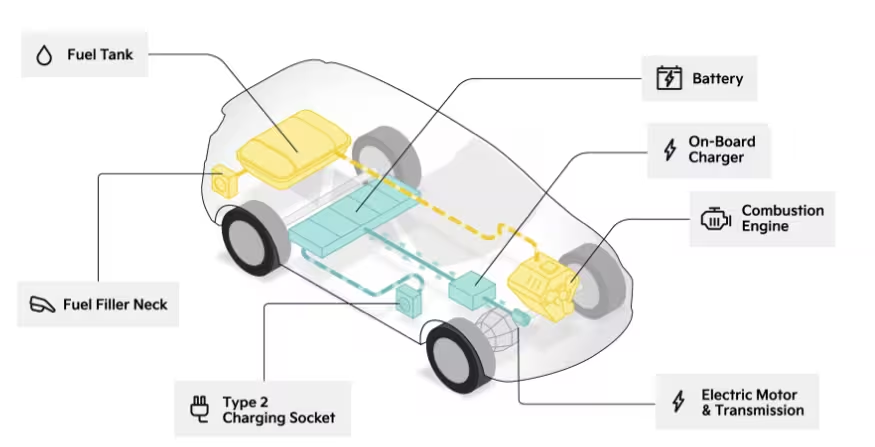
In the Ram 1500 REV architecture, for instance, the 3.6-liter Pentastar® V6 engine does not mechanically drive the wheels. Its sole purpose is to produce energy for the generator, while electric motors remain responsible for moving the truck. This separation enables the engine to operate independently of road speed and accelerator position, unlike engines in typical petrol pickups where their speed and load are intrinsically linked to driving conditions.
While the exact definition can vary among manufacturers—some systems may incorporate a mechanical connection under limited conditions, while others are purely series-based—EREV is best understood as a description of a vehicle designed for primary electric motor propulsion, with onboard fuel extending its travel distance.
How Is an EREV Different From a Hybrid?
Understanding the distinctions between various electrified powertrains is crucial:
Why EREVs Are Gaining Attention Now
The demand for electric cars is undoubtedly growing, yet the transition is progressing at varied speeds across different markets. The International Energy Agency reported that global electric-car sales surged by over 20% in 2025, reaching approximately 21 million units, meaning one in four cars sold worldwide was electric. This growth was particularly robust in China, Europe, and emerging markets, while sales in the United States showed a different trend.
This uneven picture is significant. It reveals that while many buyers are receptive to electrification, factors such as price, policy, charging access, and vehicle type heavily influence their final decision. A compact electric car primarily used in a dense city has vastly different requirements compared to a full-size pickup expected to tow, haul cargo, and traverse areas with limited fast chargers.
Increasing battery capacity can extend range, but a larger battery also adds considerable cost and weight, demanding more time and electrical power for recharging. Installing an onboard generator provides manufacturers with an alternative: offer sufficient battery capacity for typical daily electric use, and then use liquid fuel to support occasional long-distance journeys.
This approach holds particular appeal for large vehicles. Electric motors deliver potent torque from low speeds, perfectly suiting the smooth acceleration and heavy-duty workloads expected from premium SUVs and pickups. The generator then offers an additional layer of range security without altering the electric nature of the drive at the wheels.
The renewed industry interest extends beyond a single manufacturer. The Wall Street Journal has reported that Hyundai, Ford, and Stellantis (the parent company of Ram and Jeep®) are among the automakers developing larger extended-range vehicles. Their involvement indicates that EREVs are being considered a legitimate product category, moving beyond a niche technology.
The Ram 1500 REV Shows What an EREV Pickup Can Do
The forthcoming Ram 1500 REV stands as one of the clearest illustrations of how range-extender technology can be effectively applied to a full-size pickup. Ram describes it as a range-extended electric truck, featuring a liquid-cooled 92-kWh battery, a 130-kW generator, and a 3.6-liter Pentastar® V6 petrol engine.
According to Ram's current preproduction estimates, this system is projected to deliver an impressive 647 horsepower and 610 lb-ft (approximately 827 Nm) of torque. The anticipated acceleration time from 0 to 60 mph (0 to 97 km/h) is a swift 4.5 seconds. These figures conclusively demonstrate that the range-extender layout is not merely about energy conservation; it also provides the immediate, performance-oriented response expected from a modern electric truck.
The headline figure for the Ram 1500 REV is its projected total driving range of up to 690 miles (approximately 1,110 kilometers) when the battery and generator system operate in tandem. Ram also lists a maximum towing capacity of 14,000 lb (approximately 6,350 kg) and a maximum payload of 2,625 lb (approximately 1,191 kg), when the truck is correctly configured.
Charging remains an integral part of the ownership experience. The Ram 1500 REV is designed to accommodate DC fast charging at up to 145 kW, which Ram states can add as much as 50 miles (approximately 80 kilometers) of electric range in around ten minutes under suitable conditions. Owners who charge regularly could complete many shorter journeys using battery power, reserving the generator for extended or more demanding trips.
It is important to note that these are manufacturer projections for a preproduction vehicle, not guaranteed results in every driving situation. Factors such as speed, temperature, payload, trailer weight, terrain, wheel choice, and climate-control use can all influence real-world energy consumption. Buyers should not anticipate achieving the maximum combined-range figure while simultaneously towing at the truck's maximum rated capacity.
Launch timing also requires careful consideration. Ram's product page continues to show projected availability information, while a September 2026 report from Car and Driver states that a Ram spokesperson expects the 1500 REV to arrive in 2027. Until production specifications and regional plans are finalized, the listed numbers and dates should be treated as provisional.
Jeep® Is Bringing the Idea to the Full-Size Luxury SUV
An upcoming electrified Jeep® Grand Wagoneer is anticipated to utilize a related series plug-in-hybrid architecture. Reports indicate that this system will combine a 400-volt battery with a 3.6-liter V6 engine and an onboard generator. As with the Ram system, the combustion engine's role is to generate electricity rather than directly propel the wheels.
The Grand Wagoneer is a logical candidate for this technology. Full-size luxury SUVs demand smooth performance, quiet operation, generous driving range, and ample capability for families, luggage, and towing. Electric motors can deliver near-silent low-speed movement and immediate response, while the generator can provide crucial support for long highway journeys that extend beyond the available battery charge.
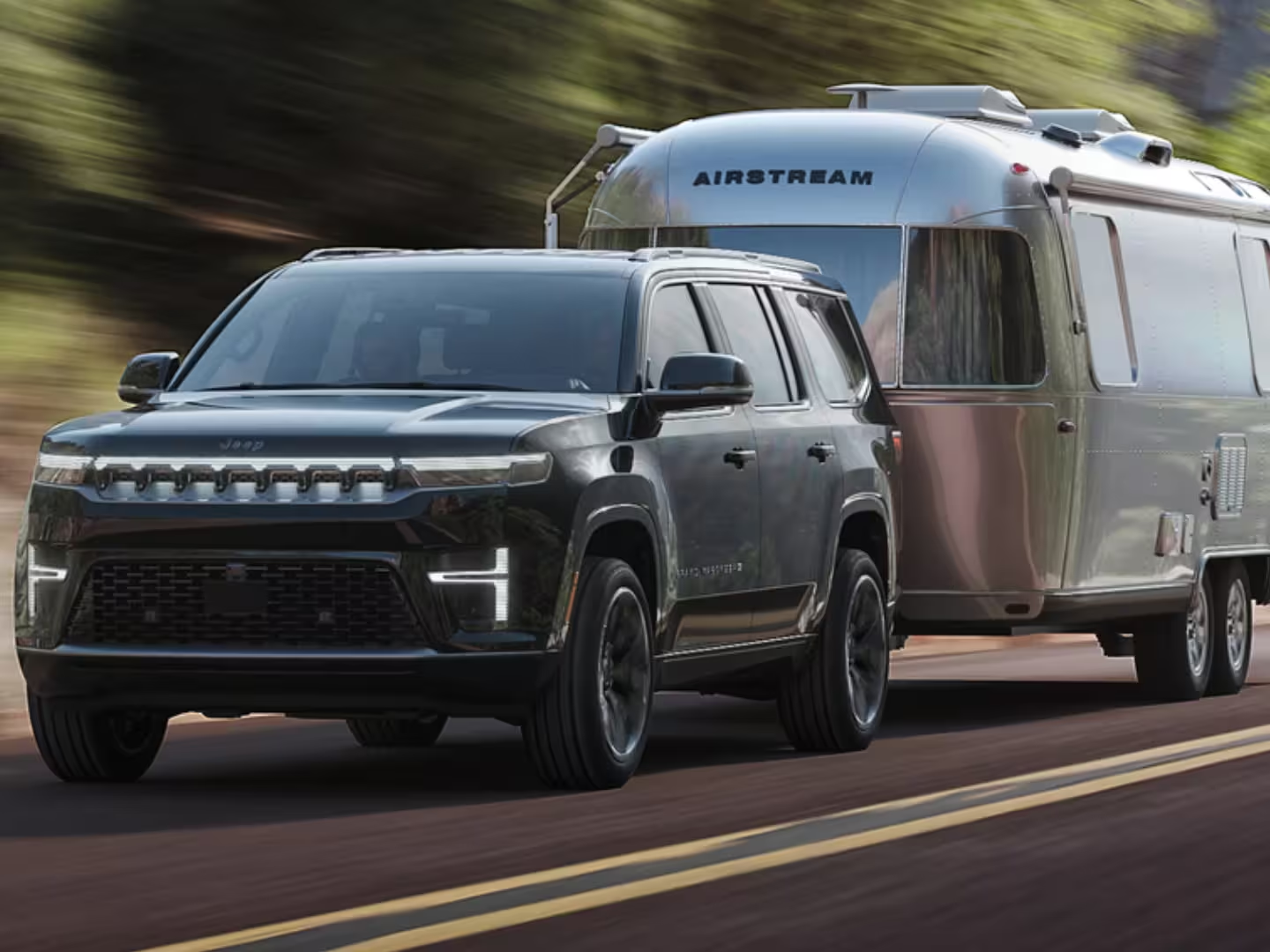
This electrified version should not be confused with the current 2026 Grand Wagoneer already featured on Jeep's consumer website, which uses the 3.0-liter Hurricane twin-turbocharged petrol engine and produces up to 420 horsepower. The range-extended model represents a separate, upcoming powertrain whose final specifications, production timing, and market availability are yet to be confirmed.
Car and Driver reported in early September that production of the Grand Wagoneer hybrid had been moved to November 2026 as Stellantis worked towards a smooth launch of the shared powertrain technology. Jeep indicated that its plans remained on track for 2026, though no GCC launch schedule has been announced.
Why This Technology Could Make Sense in the Gulf
The UAE and Saudi Arabia present an interesting test case for range-extended vehicles. Many owners complete predictable daily trips within major cities, where reliable home or workplace charging could cover a significant portion of their driving. Yet, the same vehicle may also be used for much longer intercity journeys, family travel, desert access, or towing.
An EREV could proficiently handle the first type of use primarily with stored electricity and the second with crucial support from its onboard generator. A driver with consistent home charging could begin most days with a charged battery, enjoy smooth electric operation in traffic, and only visit a petrol station when longer travel demands it.
The generator also significantly reduces dependence on the location and availability of public chargers. While it doesn't eliminate the value of a robust charging network, it provides the driver with an invaluable alternative when a charger is occupied, unavailable, or too far from the planned route.
Hot weather remains a genuine consideration. Air conditioning consumes energy in every type of vehicle, and FuelEconomy.gov notes that its percentage effect can be greater in hybrids, plug-in hybrids, and electric vehicles. A range extender does not render an electrified vehicle immune to high-temperature efficiency losses. Its advantage is that petrol can supply additional energy when battery consumption rises, assuming the vehicle has fuel and its thermal-management systems are operating correctly.
Regional specifications will be equally important. Cooling capacity, charging compatibility, software services, warranty coverage, and access to trained technicians should all be confirmed before purchasing an advanced electrified vehicle. A headline range number alone is insufficient to establish whether a particular version is suitable for long-term ownership in the Gulf.
An EREV Is Most Effective When It Is Regularly Charged
The presence of a petrol generator might lead one to believe an EREV never needs to be plugged in. Technically, it may continue operating as long as fuel is available, but utilizing it in this manner overlooks much of its core benefit.
The most significant efficiency and refinement benefits are likely to be realized when the battery is charged frequently. This allows the owner to leverage grid electricity for daily driving and rely on the engine only when genuinely necessary. If the vehicle is rarely plugged in, it must consistently carry the substantial weight of a large battery, electric motors, an engine, a generator, and a fuel system while regularly burning petrol.
This makes access to overnight or workplace charging a critical component of the buying decision. A customer who can reliably charge at home and occasionally undertakes long-distance journeys may be an ideal EREV user. Conversely, someone without dependable charging may find that a conventional self-charging hybrid remains simpler and more suitable for their needs.
The Advantages Come With Additional Complexity
Range-extended electric vehicles brilliantly solve one concern by incorporating two distinct energy systems. While this creates impressive flexibility, it also introduces inherent trade-offs.
An EREV still includes a combustion engine that requires regular servicing and produces tailpipe emissions when in operation. It also carries high-voltage components and a substantial battery. Packaging both systems can increase overall vehicle weight, and owners become dependent on technicians who possess expertise in both the electrical and combustion aspects of the powertrain.
The initial purchase cost may also be higher than that of a comparable petrol or conventional hybrid vehicle, as the manufacturer must provide a battery, electric drive motors, power electronics, an engine, and a generator. Long-term value will be influenced by reliability, warranty protection, the fluctuating costs of fuel and electricity, charging habits, and eventual resale demand.
Furthermore, EREVs do not render range estimates absolute. Heavy towing, high speeds, steep terrain, and intensive air-conditioning use all demand more energy. While the generator provides a valuable backup, owners must still plan journeys realistically and understand that maximum laboratory or manufacturer estimates are achieved under specific, controlled conditions.
Conventional Hybrids Are Not Being Replaced
The emergence and growth of EREVs do not render today's conventional hybrids obsolete. Conventional hybrid systems remain lighter, mechanically familiar, and user-friendly because they do not require external charging. They can be particularly appealing to buyers seeking improved response or fuel efficiency without altering their daily routine.
The 2026 Toyota Tacoma TRD Off-Road Premium i-FORCE MAX Hybrid, available through Automax®, serves as an excellent example. Its turbocharged 2.4-liter four-cylinder hybrid system generates 326 horsepower and 630 Nm of torque while retaining four-wheel drive and serious off-road capabilities. The related Toyota 4Runner i-FORCE MAX also combines hybrid assistance with the practical, familiar refueling experience drivers already know.
These Toyota systems utilize electrification to support a combustion-led powertrain, whereas the upcoming Ram 1500 REV employs a combustion engine to support electric propulsion. While the two approaches may sound similar, they prioritize different ownership patterns. A conventional hybrid is well-suited for drivers who prefer not to plug in, while an EREV is most compelling for those who desire to travel electrically most of the time but require petrol-backed flexibility for specific journeys.
Should UAE and Saudi Buyers Wait for an EREV?
There is no universal answer for every driver. EREVs could become especially attractive to customers who can charge at home, cover predictable distances during the working week, and regularly undertake longer journeys at weekends. They may also strongly appeal to pickup and large-SUV buyers who desire electric torque without making every trip entirely dependent on public charging infrastructure.
Buyers who require a vehicle immediately have strong alternatives readily available. Modern petrol pickups offer proven long-distance capability and rapid refueling, while current hybrids provide useful electrification benefits without demanding charging infrastructure. The correct decision hinges on daily distance traveled, access to a charger, towing requirements, ownership duration, and the availability of local after-sales support.
It is also premature to assume that every internationally announced EREV will be offered with GCC specifications. The Ram 1500 REV and electrified Grand Wagoneer remain upcoming products, and their regional availability has not yet been confirmed. Customers should await official GCC specifications before relying on announced North American performance, charging, or launch information.
EREVs Could Become the Bridge Large Vehicles Need
The electric transition is clearly no longer following a single, simple path. Battery-electric vehicles are expanding their footprint, conventional hybrids remain immensely popular, and manufacturers continue to refine efficient petrol engines. Range-extended electric vehicles add yet another compelling option, specifically designed for buyers who desire electric propulsion but are not yet ready to depend entirely on a charging network.
For compact city cars, an onboard generator may be an unnecessary addition. However, for a heavy pickup or full-size luxury SUV expected to tow substantial loads and cover long distances, the calculation is significantly different. The ability to charge at home, drive through responsive electric motors, and refuel with petrol when necessary could prove to be a highly practical and desirable combination.
The Ram 1500 REV will serve as one of the most critical tests of this technology. Its projected 1,110-kilometer combined range, 647 horsepower, 827 Nm of torque, and substantial towing capacity clearly demonstrate the technology's immense potential. However, production vehicles must still prove their efficiency, reliability, and performance in real-world use. Jeep's upcoming Grand Wagoneer will similarly test whether the same idea can deliver the quietness and convenience expected from a large luxury SUV.
August 2026 provided undeniable evidence that buyers are moving beyond conventional petrol power, but it also underscored why the industry cannot rely on a single solution for every market and lifestyle. If EREVs deliver their promised combination of electric response and long-distance flexibility, they may well become one of the most important powertrain categories for the next generation of SUVs and pickup trucks.
Frequently Asked Questions
What does EREV mean?
EREV stands for range-extended electric vehicle. It normally describes a vehicle driven primarily by electric motors that also carries a combustion engine and generator to produce additional electricity when required.
Is a range-extended EV the same as a hybrid?
Both use combustion and electric components, but their priorities differ. A conventional hybrid normally uses its engine as a main source of mechanical propulsion. In an EREV such as the upcoming Ram 1500 REV, the electric motors drive the wheels and the petrol engine generates electricity.
Does an EREV need to be plugged in?
An EREV may be capable of continuing on petrol-generated electricity without external charging, but regular charging is important if the owner wants to maximize electric driving and reduce fuel use.
Does the petrol engine in the Ram 1500 REV drive the wheels?
No. In Ram's announced architecture, the 3.6-liter V6 powers an onboard generator. Electric motors provide the propulsion at the wheels.
How far can the Ram 1500 REV travel?
Ram currently projects a total driving range of up to 690 miles, or approximately 1,110 kilometers, using the battery and range-extender system together. This is a preproduction manufacturer estimate, and actual range will depend on driving and operating conditions.
Are range-extended EVs suitable for hot Gulf weather?
They could be useful because the petrol generator provides additional energy when required, but air conditioning and extreme temperatures still affect efficiency. Buyers should confirm that the exact vehicle has GCC specifications, compatible charging, and appropriate regional support.
Can I buy the Ram 1500 REV from Automax® now?
The range-extended Ram 1500 REV is an upcoming model, and GCC availability has not been confirmed. Automax® currently offers other brand-new Ram 1500 configurations, including Hurricane-powered, HEMI® eTorque, and performance-focused models, subject to stock availability.