Tesla Roadster: Unpacking the 'Flying Car' Phenomenon
By Adam Chehayeb
Tesla's new Roadster prototype wowed with airborne maneuvers. We delve into the technology, configurations, and future reality of this 'flying car' for UAE and GCC buyers.
Introduction: The Tesla Roadster Redefines Automotive Spectacle
A Tesla driving upside down, rotating through the air, and returning to its wheels sounds like a scene ripped directly from a futuristic film. Yet, this extraordinary display is precisely why the new Tesla Roadster is currently dominating automotive conversations worldwide. At its October 15 demonstration in Texas, Tesla unveiled a prototype capable of brief airborne manoeuvres, instantly reigniting interest in the long-awaited electric sports car and posing a compelling question: has Tesla truly built a flying car?
The prototype showcased its airborne capability within a controlled setting, which is a crucial distinction. It did not establish a practical vehicle designed for routine flight between destinations or for bypassing traffic. Customer production remains a future ambition, with Elon Musk reportedly pointing to 2028 as a target. For buyers following this unfolding story from the UAE and the wider GCC, understanding this distinction is essential. The thrilling aspect lies in the engineering innovation; the unanswered questions revolve around how much of this will reach customers, in what configuration, and under what conditions.
The Spectacle in Texas: What Happened at the Roadster Reveal?
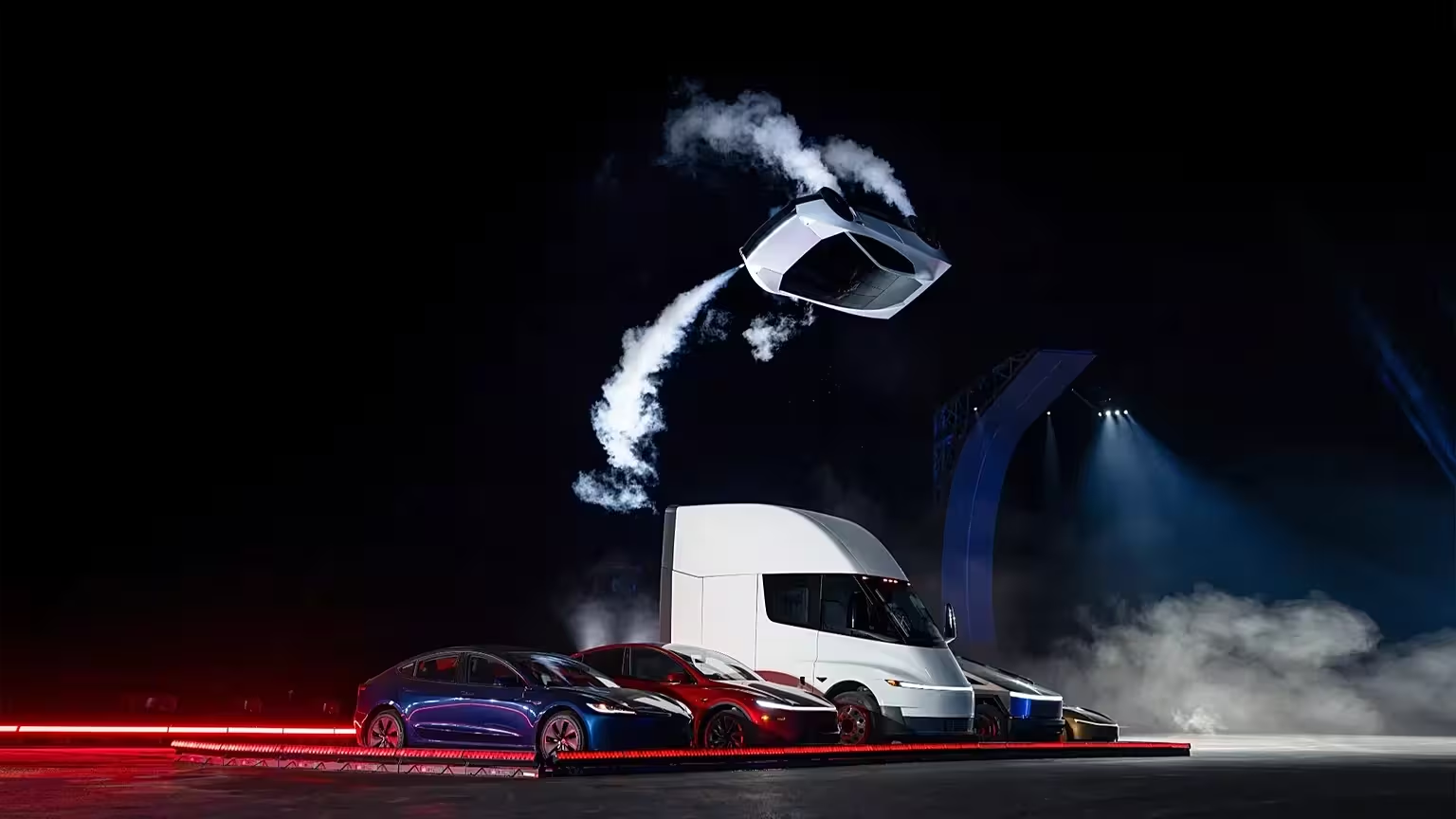
The presentation at SpaceX’s McGregor facility was nothing short of cinematic. It featured the Roadster prototype climbing a curved structure, moving upside down, and then performing a rotation in the air before executing a controlled landing. This visual feat was paired with another impressive claim: an acceleration time of 0.81 seconds to 60 mph, approximately 97 km/h. These were Tesla’s demonstrations and measurements, presented as a manufacturer highlight.
The provided image vividly captures the dramatic essence of the event. Against a dark, theatrical backdrop, a white Tesla Roadster prototype is seen suspended in mid-air, oriented upside down. Plumes of white vapor, indicative of the cold-gas thrusters, stream dynamically from its underside, giving the impression of powerful propulsion. Below this airborne marvel, an array of other Tesla vehicles stands on a brightly lit stage. A prominent white Tesla Semi truck forms a central anchor, flanked by a sleek red Tesla Roadster and a deep blue Tesla sedan, possibly a Model 3 or Model S. The scene is illuminated by focused spotlights and a striking red light strip on the ground near the blue car, underscoring the high-production nature of the demonstration.
It is important to note that a manufacturer demonstration, while showcasing a prototype's capabilities under prepared conditions, does not automatically establish repeatability in customer vehicles or an independently verified production-car record. This explains why the footage has garnered such immense attention. While most sports-car launches typically compete through familiar metrics like power output, acceleration times, lap records, and top speed, Tesla introduced an unprecedented visual moment that requires almost no explanation before it goes viral.
Beyond the Hype: How Does the Tesla Roadster Leave the Ground?
The new Roadster’s ability to leave the ground is a result of combining electric propulsion with two sophisticated additional systems: suction-generated downforce and compressed-gas thrust. Tesla describes a system of fans and a ground-sealing arrangement designed to remove air from beneath the car, creating suction. Separately, cold-gas thrusters produce directional force. The airborne 'Rocket' configuration specifically places thrusters around the vehicle to support movement upwards, forwards, and through rotation, as outlined in Tesla’s Roadster overview.
The functional difference between these two systems is straightforward. The suction system primarily aids in keeping the tyres pressed firmly against a nearby surface, enhancing grip. Conversely, the thrusters are designed to apply force after the tyres have lifted off the surface. Therefore, stating that “the fans make it fly” oversimplifies a crucial part of the explanation; the same vehicle employs distinct tools for different stages of its remarkable demonstration.
Engineering Insights: The Trade-Offs of Extreme Performance
In a direct interview with Hagerty, Tesla vehicle-engineering vice president Lars Moravy shed further light on the Roadster’s capabilities. He detailed that the vehicle features two electric motors driving the rear wheels, boasting an output exceeding one megawatt, which translates to roughly 1,340 horsepower, and torque of approximately 1,400 Nm. However, he also elucidated the significant packaging trade-off involved in achieving such extreme performance.
The 'Thrust' system incorporates a compressed-nitrogen tank located behind the seats. The more extreme 'Rocket' configuration, responsible for airborne capabilities, necessitates additional storage in the passenger-seat area for more nitrogen, along with supplementary thrusters. This transforms the most extreme version of the Roadster into a single-seater. These remain engineering claims about a developing vehicle, highlighting that exceptional capability often comes with compromises, particularly for the customer. Adding spectacular features can significantly alter cabin space, operating requirements, and the fundamental way a vehicle is used, making a spectacular feature rarely separate from the overall ownership experience.
Understanding the Roadster Lineup: Performance, Thrust, and Rocket Explained
Tesla’s current product page differentiates between a 'Performance' model and two 'augments' named 'Thrust' and 'Rocket'. Understanding these distinctions is paramount for interpreting the Roadster’s potential:
These differences must guide how readers interpret headlines and specifications. A performance figure or capability attributed to the Rocket configuration cannot simply be applied to every Roadster variant. Equally, describing the Performance model as intended for road use does not imply approval for the Rocket’s airborne functions. For anyone comparing future electric sports cars, the specific configuration will be as critical as the model name itself.
Flying Car or Airborne Stunt? Defining the Tesla Roadster's Capability
The phrase “flying Tesla” powerfully captures the spectacle, but it can unfortunately evoke very different expectations. One reader might envision a car briefly lifting its wheels off the ground, while another might imagine a vehicle taking off from a driveway, cruising above a city, and landing at a distant destination. These represent substantially different products and levels of functionality.
The October demonstration unequivocally showed short airborne manoeuvres within a controlled environment. However, publicly available information does not establish a certified flight envelope, a practical aerial journey distance, or routine passenger flight operations. Reporting on the reveal also noted that Tesla has not disclosed how long or how far the Rocket configuration could remain airborne. Therefore, the most accurate and useful description today is that of a developing electric sports car featuring an exceptional airborne configuration. Whether this evolves into a practical customer product depends on much more than merely repeating the launch stunt.
Contextualizing the Acceleration Claims: Speed Beyond the Numbers
Achieving approximately 97 km/h (60 mph) in less than a second would place extraordinary emphasis on the precise test method employed. Factors such as the start point, surface conditions, specific tyres used, assistance systems engaged, and the exact vehicle configuration all significantly influence the result. Moreover, a rollout measurement, which starts timing after an initial movement has occurred, should not be presented as equivalent to a full standing-start measurement, which begins from a complete standstill. Hagerty specifically identifies the more extreme 0.55-second Rocket claim, discussed in its engineering interview, as a rollout figure.
Readers should also be careful to avoid directly converting a quoted zero-to-60-mph result into a zero-to-100-km/h result. Sixty miles per hour is approximately 96.6 km/h, meaning these tests conclude at slightly different speeds. For Automax® readers, the truly meaningful comparison will ultimately come from independently measured results from production vehicles, conducted under clearly stated and consistent conditions.
Anticipating Availability and Pricing: A Look at the Future
Regarding availability, Elon Musk has identified 2028 as the production target, according to reporting from the reveal. It is crucial to understand that this is a target rather than a confirmed delivery date. Tesla’s updated US Roadster Reservation Agreement, dated October 15, explicitly states that the vehicle remains under development and that Tesla cannot guarantee when delivery will happen, or even if it will happen.
Development, production, and delivery are distinct milestones. A reveal can effectively demonstrate technical progress while leaving critical manufacturing and logistical details unresolved. Furthermore, commencing production does not automatically mean every market or configuration will receive vehicles immediately. Until Tesla publishes a firmer schedule, describing this as a confirmed “2026 production model” would misrepresent the current position.
On the pricing front, Tesla’s reservation terms clearly distinguish a payment for approximate ordering priority from a completed vehicle purchase. Final configuration choices and purchase agreements will follow later, and the exact purchase price remains unconfirmed while development continues. This distinction is particularly relevant when a headline quotes a large booking amount; a deposit should not be mistaken for the car’s final retail price. For prospective buyers, the pertinent questions extend beyond the initial payment to include the final specification, total price, precise delivery timing, applicable terms, and the exact equipment included.
The UAE and GCC Perspective: Local Realities for the Roadster
For buyers in the UAE and wider GCC, regional considerations are paramount. While Tesla maintains a UAE Roadster page, it includes a significant regional caveat: availability is subject to local legal requirements and applicable laws. A local webpage, or even the ability to reserve a vehicle, does not automatically confirm that every configuration or capability has been approved for use in the country, nor does it guarantee a delivery date or permission to perform its airborne manoeuvres.
For UAE and GCC buyers, the practical questions will revolve around the final regional specification, registration eligibility for specific configurations, the availability of servicing arrangements, and the officially approved uses of their chosen Roadster variant. At this stage, there is no basis for promising that customers will be able to fly a Roadster over Dubai traffic or any other public airspace.
Beyond the Spectacle: The Broader Impact of Tesla's Innovations
The Tesla Roadster attracts significant attention because it translates high performance into something visibly dramatic. A viewer doesn't need to comprehend complex battery chemistry or intricate motor output figures to react powerfully to a sports car leaving the ground. However, our view is that the longer-term significance of this project could lie in the less theatrical but equally important ideas: the pursuit of greater grip, the sophisticated coordination of advanced vehicle controls, and the exploration of how an electric car behaves at its absolute performance limits. These engineering pursuits remain profoundly interesting and impactful, even if airborne driving remains confined to specialised settings.
There is also a familiar and crucial distinction between a car that demonstrates what engineers are capable of attempting and one that reliably delivers a dependable, practical ownership experience. Both types of vehicles can influence the broader automotive industry, but buyers require very different evidence to justify an investment in each. The next truly important updates for the Tesla Roadster will pertain to production readiness, independently tested performance figures, and confirmed regional availability.
Conclusion: The Road Ahead for the Tesla Roadster
The new Tesla Roadster has undoubtedly earned global attention through a remarkable prototype demonstration, pushing the boundaries of what is conceivable for an electric sports car. Its next significant challenge is to transition that captivating moment into a clearly specified, production-ready product that meets regulatory standards and customer expectations across various markets. Automax® will continue to provide comprehensive coverage of major vehicle launches and the critical developments that matter most to buyers and automotive enthusiasts across the UAE and GCC. To explore vehicles currently offered, we invite you to browse the Automax® inventory or contact our expert team for current specifications and availability.