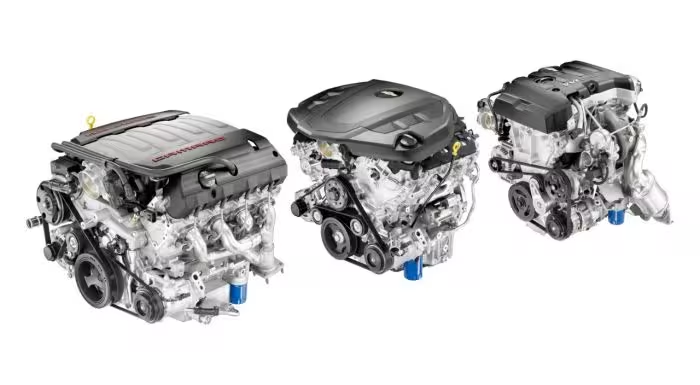
Bigger Engines vs. Smaller Engines in 2026: The New Performance Equation
By Adam Chehayeb
The automotive world is evolving. Discover if traditional bigger engines still make sense in 2026, or if smaller, smarter engines now dominate performance and efficiency.
Introduction: Redefining Automotive Performance in 2026
For decades, the automotive world operated on a simple principle: bigger engines meant better performance. More cylinders, larger displacement, and often, higher fuel consumption were the hallmarks of greater power, exhilarating acceleration, and a truly exciting driving experience. This conventional wisdom shaped buyer perceptions and engineering priorities across the globe. However, as we look towards 2026, the automotive industry is undergoing a rapid and transformative shift, rendering that traditional equation far less straightforward than it once was. The landscape of power and efficiency is being dramatically reshaped by innovation.
Today, thanks to remarkable advancements in engine technology, sophisticated turbocharging systems, and an unwavering focus on efficiency-driven engineering, smaller engines are demonstrating capabilities that not only rival but frequently surpass the performance levels of older, large-capacity engines. This paradigm shift compels a crucial question for contemporary buyers and enthusiasts alike: In an era defined by smart technology and sustainable practices, do bigger engines still hold their traditional appeal, or do they still make practical and economic sense?
The Rise of Smaller, Smarter Engines: A New Era of Power
Modern vehicles are unequivocally trending towards adopting smaller displacement engines, a design philosophy frequently enhanced by the integration of advanced turbocharging technology. These meticulously engineered engines are crafted with a dual objective: to maximize power output while simultaneously minimizing fuel consumption. This innovative approach strikes a delicate yet effective balance that is ideally suited for the multifaceted demands of today’s driving needs, from urban commutes to highway cruising.
Consider the capabilities of a contemporary 1.5-liter or 2.0-liter turbocharged engine. These compact powerhouses are now capable of generating power figures that were, in the not-so-distant past, exclusively the domain of much larger V6 or even V8 engines. More critically, these advanced smaller engines are designed to deliver peak torque earlier in the RPM range, a characteristic that translates into a noticeably more responsive and engaging feel in everyday driving scenarios. Whether navigating congested city traffic or executing confident merges onto busy highways, the immediate throttle response and robust pulling power make these engines exceptionally practical and enjoyable. This strategic shift is particularly pertinent in dynamic markets such as the UAE, where drivers consistently seek an optimal blend of exhilarating performance and commendable efficiency, all without incurring excessive fuel costs.
Performance Is No Longer Just About Size: The Role of Technology
Historically, engine size stood as the predominant, almost singular, factor in determining a vehicle's performance capabilities. A larger engine inherently promised more power and speed. However, in the current automotive landscape, technology has ascended to play an overwhelmingly significant and multifaceted role. The holistic performance of a car is now a complex interplay of numerous advanced systems, where the engine is just one component of a meticulously integrated whole.
Cutting-edge advancements like sophisticated direct fuel injection systems, precision-tuned multi-speed transmissions, and innovative lightweight vehicle construction all contribute synergistically to how a car performs on the road. These technological leaps enable even smaller displacement engines to achieve remarkable feats. As a direct consequence, a modern four-cylinder engine can frequently outperform an older six-cylinder engine in real-world driving conditions. Acceleration feels demonstrably quicker, throttle response is sharper and more immediate, and overall fuel efficiency is significantly improved, offering a compelling package that challenges traditional notions.
It is crucial to clarify that this evolution does not imply that bigger engines have entirely relinquished their competitive edge. Rather, it signifies that their once-dominant advantage is no longer as absolute or unchallenged as it once was, forcing a re-evaluation of what true performance means in the modern era.
Where Bigger Engines Still Shine: Unrivaled Power and Character
Despite the undeniable and impactful shift towards more compact and efficient engines, larger engines unequivocally retain a vital and relevant place within the automotive ecosystem. There are distinct driving scenarios and specific vehicle applications where raw size and substantial displacement continue to be paramount, offering advantages that smaller engines simply cannot replicate, regardless of how advanced their technology may be.
Vehicles purpose-built for heavy-duty performance, such as full-size SUVs and robust pickup trucks, often derive immense benefit from the inherent strength and endurance of larger engines. These formidable powerplants are designed to provide consistent, unwavering power under sustained load, making them inherently better suited for demanding tasks like towing substantial trailers, confidently navigating challenging off-road terrain, or reliably carrying heavy payloads. Their generous displacement provides the effortless grunt required for such arduous work.
Beyond pure utility, there is also a profound emotional factor that continues to resonate deeply with many drivers. A significant segment of enthusiasts still expresses a strong preference for the distinctive sound, the visceral feel, and the unique character inherent in a larger engine. The smooth, linear power delivery and the deep, resonant engine note typically associated with a V6 or V8 create a truly immersive and traditional driving experience. This sensory appeal, a blend of auditory satisfaction and tactile feedback, is something that smaller engines, even those expertly augmented with turbocharging, often find challenging to fully replicate.
Efficiency and Cost Considerations: The Practical Side of Engine Choice
One of the most compelling and practical reasons driving buyers away from larger engines is the undeniable advantage in efficiency offered by their smaller counterparts. Smaller engines, by their very nature, typically consume less fuel, a direct benefit that translates into significantly lower running costs over the lifespan of the vehicle. This economic consideration holds particular importance for daily drivers who spend considerable time navigating city traffic, where stop-and-go conditions can rapidly deplete fuel tanks with larger, thirstier engines.
The financial benefits extend beyond just fuel savings. Smaller engines frequently come with the added advantages of lower maintenance costs, owing to fewer components or simpler designs, and often more affordable insurance premiums due to their typically lower power output or perceived risk. When viewed over the entire ownership period of a vehicle, these accumulated factors can collectively make a noticeable and substantial difference in the overall financial outlay of owning and operating a car.
However, it is equally important to acknowledge that for drivers whose primary priorities are uncompromised power, exceptional capability, and the unique experience of a larger engine, the additional expenditure associated with a bigger powerplant may still be fully justified. For these individuals, the intangible benefits often outweigh the tangible cost differences.
The Influence of Modern Technology: Bridging the Engine Gap
Technology continues to be a monumental force, playing an integral and transformative role in fundamentally reshaping how automotive engines are both developed and ultimately utilized. Modern vehicle systems are increasingly sophisticated, offering a suite of features designed to optimize performance and efficiency irrespective of the engine's physical size.
Features such as intelligent start/stop systems, which momentarily shut off the engine during idle, advanced multi-gear transmissions that precisely manage power delivery, and intelligent driving modes that adapt engine characteristics to different conditions, all contribute to an optimized driving experience. These innovations help to extract the maximum potential from any engine, whether it’s a compact turbocharged unit or a larger displacement V8.
Even in vehicles equipped with traditionally larger engines, manufacturers are intensely focused on enhancing efficiency, not merely by increasing displacement, but through smarter and more refined engineering. This concerted effort means that the performance and efficiency gap between smaller and larger engines is progressively narrowing. Consequently, the decision-making process for buyers is evolving, becoming less about raw specifications and more about aligning the engine choice with specific usage patterns, individual driving habits, and personal preferences.
So, Are Bigger Engines Still Worth It in 2026?
The definitive answer to whether bigger engines are still 'worth it' ultimately hinges on the individual driver's specific needs, priorities, and driving lifestyle. For the vast majority of consumers, modern smaller engines, especially those with turbocharging, provide more than ample performance for daily driving tasks. They deliver brisk acceleration, responsive handling, and crucial benefits such as superior fuel economy and significantly lower overall running costs. For these practical considerations, they represent a smarter, more pragmatic, and economically sound choice in today’s highly competitive and evolving automotive market.
However, it is equally important to state that bigger engines are unequivocally far from obsolete. They continue to offer distinct and compelling advantages in particular situations, making them indispensable for certain segments of the market. This is especially true for drivers who genuinely require extra raw power, robust towing capability, or those who simply cherish and seek out a more traditional, perhaps even nostalgic, driving experience characterized by a specific engine sound and feel. For these discerning buyers, the value proposition of a larger engine remains robust and entirely justified.
Final Thoughts: Finding Your Balance in the New Automotive Era
In 2026, the decision of choosing between a big engine and a smaller one is no longer a simplistic matter of right or wrong, or an outdated debate between superior and inferior. Instead, it has evolved into a sophisticated process of understanding your precise needs, critically evaluating your driving habits, and determining how you intend to utilize your vehicle on a day-to-day basis. The era of one-size-fits-all engine solutions is rapidly fading.
If your primary priorities are efficiency, long-term affordability, and the responsive, modern performance delivered by contemporary engineering, then smaller turbocharged engines emerge as the clear and compelling winner. They offer a forward-thinking solution that aligns with current economic and environmental considerations. But conversely, if you place a premium on raw, unadulterated power, formidable capability for heavy-duty tasks, and the distinctive character and emotional connection of a larger engine, then bigger engines undeniably retain a strong and enduring place in the market.
The ultimate key lies in meticulously finding the perfect balance that genuinely works for you and your unique requirements. Because in today’s dynamic and technologically advanced automotive world, true performance is no longer singularly defined by engine size alone; it is a nuanced blend of power, efficiency, and purpose.